Pages

Thursday, April 30, 2015

A Historian at the Cinema: When The Moors Ruled Europe

For most of us, world history classes are really just a bad code word for European history. Most people are aware of the basic of European history (Roman Empire, then Dark Ages, then Renaissance, the fast forward to World Wars and that's the gist of it). A part of European history that is often overlooked due to an agenda or pure ignorance is the period of 700 years in which the Moors, North African Muslims, controlled and ruled Spain and Portugal between 711 to 1492 CE. What resulted from this conquest of the Iberian peninsula was a thriving, modern, and sophisticated society during a time when the rest of Europe was living through the Dark Ages.

The documentary film, When the Moors Ruled Europe, produced by the British Acorn Media company and presented by historian Bettany Hughes, guides viewers through this history that although forgotten by many but that is still visually and physically present throughout the Spanish and Portuguese countryside. Sites such as Andalucia, Granada, and Cordoba contain the physically remains of this high period in European history. Hughes takes the audience through a history that began in conquest and the creation of the kingdom of Al-Andalus (modern day Spain, Portugal, and southern France). Tariq ibn Ziyad lead the Moorish army against the Visigoths, who would eventually surrender. However, life under the new Moorish empire in southern Europe was complex. Moorish rulers allowed Christians to be governed by Visigoth law and the many willing Muslim converts, who converted despite little immigration from north Africa, to live under Moorish law. In addition, Arabic became the language of the land. These two factors help explains the large influence Islam had on Iberian (and as a result South American) culture and customs and the large amount of Arabic origins in the Spanish language. These long lasting influences of the Moors demonstrate how deep an impact the 700 years of Moorish rule had upon the people of southern Europe. More interestingly, the documentary is quick to point out that Moorish Europe experienced a Renaissance many hundreds of years before the rest of Europe. During this period, the Moors developed renowned learning centers and libraries, advanced medicine that would not be seen in Europe until the discovery of germs, and practical technology such as sewer and water systems. However, the Moorish Empire of Al-Andalus would eventually come to an end during the Reconquista which would end with Ferdinand and Isabella as king and queen of the newly re-Christian Spain in 1492. With Christian rulers in control of the region, Spain would quickly move to forget and cover up their Moorish history. This effort to forget the Muslim empire in Europe would prove successful up until current day when the majority of text books gloss over or omit any references to Moorish Europe. This documentary aims to bring back this history to the general population and to the popular record.
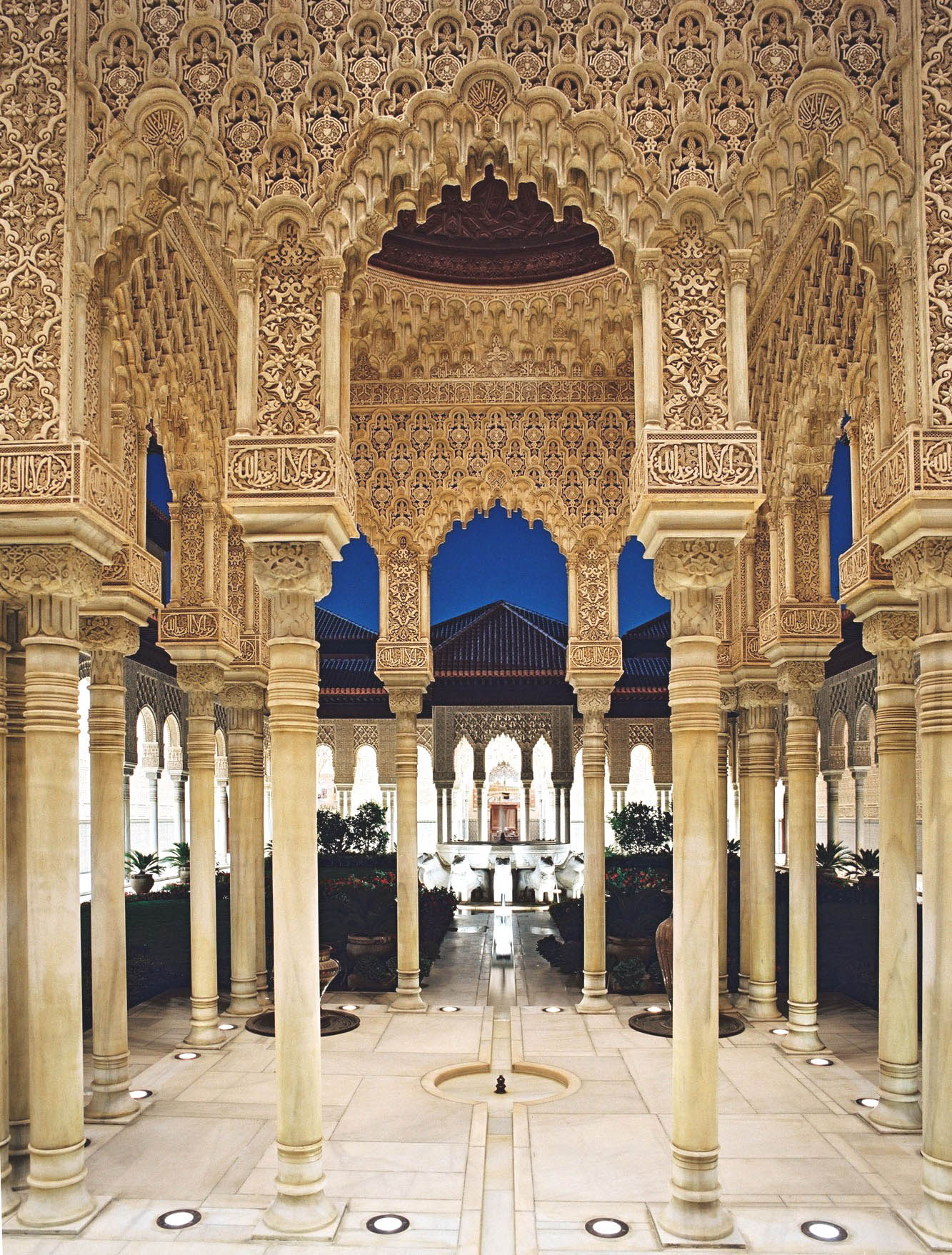
Alhambra: masterpiece of Moorish art and
architecture located in Granada, Spain. 
The high light of this film, aside from the clearly explained and rich history narrative, is that it draws upon the architectural heritage of Moorish Spain. Hughes explores and narrates this complex history while strolling through the regal and geometrically designed palaces such as Alhambra. Audiences are presented with the beautifully preserved remains of Moorish Spain as they learn about the civilization that built them. Instead of the typical Ken Burns style of slowing panning past antique photos of people and places, the producers of this documentary chose to film on site of each of the Moorish palaces or cities and used reconstructions or images during certain moments. This decision enriches the experience because it reveals to audiences the physical impact of this civilization. More importantly, the documentary does excellent work at explaining a complex 700 year history in only two hours. It serves as a primer, a well detailed one, for those interested in learning about this missing chapter in European and Arab history.

I found this documentary through a recommendation from my Arabic professor. My background as South American made this documentary all the more interesting. Learning about how Latin American traditions came from Arab and Muslim culture was enlightening and something that is rarely talked about. It revealed an aspect of the history of the Spanish language that I had never heard before and helped answer many of the questions I had about our deep seeded traditions. For this reason, I most definitely recommend this documentary to people of South and Central American decent. It provides an understanding of another layer in our extremely multicultural history. For others, it will also provide an enlightening re-examination of that European history you learned in high school social science class. The beauty of history is that it is constantly in a process of discovery and rediscovery, and it is this process that makes us richer as a society and as people.


Tuesday, April 28, 2015

History Highlight: Pineapples in Colonial America


     When one thinks of the Pineapple for many Dole and Hawaii are the first things that come to mind.  Well in America, long before Hawaii was a territory or Dole was thought into existence, the Pineapple has played a large part in social settings in America.  This historical highlight will be on the Pineapple as it was used in the American Colonies and how it is still represented today.


     Until the first time that I saw a pineapple as a carving in a facade in Thomas Jefferson's formal dining area I had no idea that it was a symbol for anything besides food.  This was the first stop of a 13 day trip around Virginia, Maryland, and Washington D.C.  Our first day of our trip placed us in Charlottesville, Virginia in the home town of Thomas Jefferson.  Jefferson was by his own admittance a farmer and often liked to entertain at home.  He had a formal dining room area where he would bring his guests.  Around the ceiling as I stared I kept seeing the reoccurring symbol of the pineapple.  Well having been from California and having visited Hawaii when I was 6, I could not understand why every where connected to Colonial America there were Pineapples.  So being one never afraid to ask questions, I asked our tour guide about it.  She told us that in the 1700's pineapples were rare, that you couldn't exactly go down to the local grocer and pick one up. They were often an item that was requested and went for high prices as they had to be shipped (by an actual ship) to cities in the American colonies.  Jefferson, like so many others would honor guests that they highly respected by presenting them with a pineapple.  The group would get to cut up this unusual fruit and it was easy to share.  

     From this point on I was obsessed with finding all of the pineapples.  Well on this particular trip, our next stop was that of Williamsburg, Virginia.  This was the first capital of Virginia and was also the seat where many decision was made that are still in affect today.  As we wandered around town, the pineapple was every where.  I became more and more interested in this small item.  Not only was it a gift given to honor a highly respected person, but it was also carved into or sculpted to mean Hospitality and Welcome.  At this point in our trip I decided that I loved everything about the pineapple.  I began to collect pineapples and bring them home with me any where that I saw them.

     So a little more history and less of my story.  The pineapple became a symbol of the American colonies.  Since towns were often small and news in a way travelled slow, visiting and socializing was one of the main forms of connectedness.  This was a main factor in the idea of hospitality.  The concept of hospitality--the warmth, charm and style with which guests were taken into ones home.

     A way that the host and hostess could entertain was through the setting of a table.  For women of the time this showcased her personality and also her families status.  Like society today, often women would try to out do one another with fanciful displays.  Often times at these feasts, small mountain ranges of tiered, pyramided and pedestaled foodstuffs often drizzled and webbed in sugar, studded with china figurines, festooned with flowers and interwoven with garlands of pine and laurel. Dinners were extravaganzas of visual delights, novel tastes, new discoveries and congenial conversation that went on for hours often late into the night.

     A hostesses's ability to have a pineapple for an important dining event said as much about her rank as it did about her resourcefulness, given that the street trade in available fresh pineapples could be as brisk as difficult.  So sought after were the prickly fruits that colonial confectioners sometimes rented them to households by the day. Later, the same fruit was sold to other, more affluent clients who actually ate it. As you might imagine, hostesses would have gone to great lengths to conceal the fact that the pineapple that was the visual apogee of their table display and a central topic of their guests' conversation was only rented.
     In larger, well-to-do homes, the dining room doors were kept closed to heighten visitors' suspense about the table being readied on the other side. At the appointed moment, and with the maximum amount of pomp and drama, the doors were flung open to reveal the evening's main event. Visitors confronted with pineapple-topped food displays felt particularly honored by a hostess who obviously spared no expense to ensure her guests' dining pleasure
     In this manner, the fruit which was the visual keystone of the feast naturally came to symbolize the high spirits of the social events themselves; the image of the pineapple coming to express the sense of welcome, good cheer, human warmth and family affection inherent to such gracious home gatherings.


Monday, April 27, 2015

A Historian at the Cinema: The Violent Years

File:The Violent Years poster.jpg
Teens, Drugs, Mischief! Oh My!
A recent injury has left me less mobile than usual so perfect time to crash on the couch and review some films. This time it is a selection from the Cult Classic collection I recently got from Fry's Electronics. The collection includes a variety of drug exploitation films from the 1930's to 1950's that represent the extreme and misinformed ideas about narcotics from the time period. Written by Ed Wood, it proves to be equal parts ridiculous and surprising.

The Violent Years (1956) tells the cautionary tale of Paula Parkins, daughter of the local newspaper editor and a socialite mother. Paula has become violent and reckless with her gang of friends from high school. They have become committing a string of gas station muggings that has the community and the local media in a frenzy. However the girls have ties to a greater mob in the area who asks the girls to do a small job. They are tasked with destroying the local high school and burning the American flag (clearly the Red Scare is in full bloom by the time of this film). The girls take no motivation to destroy the high school and for some reason that is never explained, the girls bring guns to vandalize the school. In a way they make today's school times seem tame. The vandalizing trip ends, unsurprisingly, with a gun fight and two of Paula's gang dead on the ground. Paula and her one left over accomplice quickly flee the scene and make it back to the house of the woman who is their contact with the greater gang. Once again, Paula uses her clearly proven leadership skills to outwit the police and fails. In the hospital, Paula discovers she is pregnant but dies during child birth. The child is left to the courts to decide parental rights.


Paula and her gang of worst decision makers ever!
The film was quite a surprise. I am familiar with the Reefer Madness type films of the 1930's but this one stood out. The idea that these girls are so quick to resort to violence due to drugs and alcohol are typical of these morality tales from the mid-century. However, rarely do these films show women gang raping a male victim. Reread that sentence once or twice. I was shocked. There is very little denying what happens during this scene, but the films avoids using the word rape and instead terms the event a "criminal assault". The Violent Years makes it clear to the audience that these are bad and irredeemable women, a theme that is heavily prevalent during this time period. Gender roles were much more rigid during this era than in our own (not to say we have achieved full equality yet) but this film represent the full extent of what these gender roles meant for women. There is no room for women to express themselves outside of what American society deemed appropriate. Women who demonstrated an ounce of assertiveness or self determination were quickly labeled a deviant and guilty of all that is wrong with society. This is never more apparent in the film than with the case of Paula's mother. She is a socialite and active in a variety of groups that keep her out of the home and away from her motherly duties. Keep in mind, her father is even less present in the home, but clearly that is not the issue. It is all her mother's fault and when it comes time to decide parental rights over Paula's baby, the judge deems the mother, and by default her husband, too irresponsible to handle a child and gives the baby to foster parents.

Do I recommend The Violent Years? Yes, but not because of its filmmaking, acting, message or anything intended by the director. Instead, because it is a great example of the anti-drug and juvenile delinquent hysteria of the 1950's. Also it is incredibly bad and therefore funny to watch. This being an Ed Woods film, what else do you expect? Despite this, I did have fun watching this film and it might work its way into my thesis. And be honest, who doesn't enjoy really bad movies from the 1950's?

Saturday, April 25, 2015

New Series! A Historian Reads: American Desperado

Following the beginning of our film review series, we thought it appropriate to begin a book review series as well. Historians do a lot of reading (heads up for anyone interested in entering the field), but it also happens to be a passion of ours. We will review books that deal with history but they could come from different fields and include fiction and non fiction.


After reviewing the documentary Cocaine Cowboys I thought it might be interesting to introduce you to one of the books used for the making of that documentary. American Desperado is the autobiography of one of the infamous cocaine cowboys, Jon Roberts. If you read the review of that film you will know that the cocaine cowboys refers to the period of extreme drug gang violence that occurred in South Florida during the 1980's and 1990's. Participants in this violence were called the cocaine cowboys because of the lawless nature that the region had developed.

Jon Roberts was one of these cocaine cowboys. A New York native, Roberts was one of the non-Colombian affiliates of the active cartels in South Florida. He began working as a distributor in New York in the club scene during the early 1970's and found it to be a lucrative occupation. However, he moved to Florida when the drug trade through the Caribbean exploded. Cocaine became a desired drug and the main supplier, Colombian cartels, developed extensive trade networks to get their product to the United States. Jon Robert's experience with the Gambino crime family in New York made him a perfect candidate to begin working with the up and coming Colombian cartels. Roberts claims that Cuban cartels in the area were having difficulty bringing in enough product to meet demands. Colombian cartels, who had been working exclusively in production, moved to expand their empire into manufacturing and distribution. Cuban and Colombian cartels were soon in conflict and Roberts found a niche within the Colombian cartel organization. He soon went to work with another American, Mickey Munday, a pilot who used his expertise in flight and navigation to bring up cocaine undetected. Both Roberts and Munday would eventually come under the radar of the South Florida Drug Task Force organized to deal specifically with the cocaine cowboys. A raid would lead to the arrest of Roberts and the escape of Munday. Under arrest, Roberts would eventually turn criminal informant helping the U.S government bring down many of his former colleagues.


Jon Roberts with co-author Evan Wright
This autobiography is an disturbing look into the late twentieth century drug trade by one of its important figures. Interest in this book has gone up recently since Mark Wahlburg has announced interest in making a film based on the autobiography with Wahlburg starring as Roberts. This news makes me uneasy because Hollywood does not have a good record in making accurate film about history in general, the drug war, and Colombians (that will be its own stand alone post/rant). We shall have to wait and see if this film turns out to be another misinformed glamorization film or maybe something closer to the truth. And the truth is that Roberts lived in a violent world and the nonchalant style of Robert's memoir reflects this. It becomes unsettling to read about the acts he committed or was involved in described in such a matter of fact style. Interestingly, since Roberts' death his co-author, Evan Wright, added an epilogue in which he describes his own uneasiness with Roberts' personality and violent past. Wright describes how he feared Roberts as certain times during the process of helping him write the book. As a reader, I found myself experiencing something similar to Wright. Despite this, I do believe this is an important book to the history of the drug war. It reveals the world from the inside out and demonstrates how the drug trade benefited by the war on drugs and the political climate of the United States. Moreso, Roberts' autobiography allows readers to understand the reality of the drug trade outside of the hyper-hysteria of the press and glamorization of the media that most people are familiar with. As this book shows, reality is often more horrific and sensational than anything a filmmaker than make.