Pages

Showing posts with label world history. Show all posts

Thursday, September 3, 2015

History Highlight: The Winter War

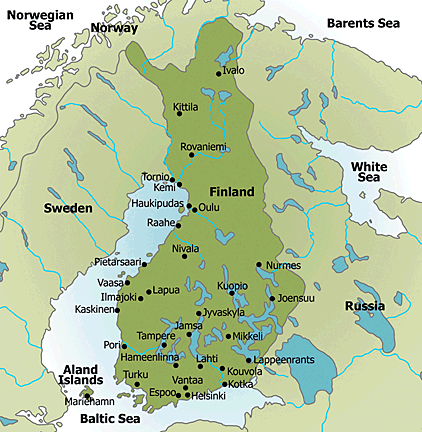
In case you forgot that Finland is that piece of land squished
between two major historical world powers. 
I have long had a odd obsession with the country of Finland. It started in middle school and their great heavy metal scene and just grew. The more I learned about the country, the more I wanted to visit it for myself. I finally got the opportunity three years ago and to this day it remains one of my most memorable trips. Finland is a country that I will definitely be visiting again in the future.

One of the most important parts of Finnish history, and key to understanding the Finnish mentality and identity, is the Winter War. This little talked about part of World War II is swept under the historical rug in almost all textbooks. However, it is tantamount to the history and course of this tiny nation of barely 6 million. The Winter War took place in less than a year between 1939 and 1940 between the Soviet Union and the just newly independent Finland. The Finns had gained independence from the Soviet Union shortly after the Russian Revolution for practical reasons. The Soviets just did not have the strength or energy to keep Finland under their power since they were dealing with their own revolution and extreme political upheaval. The Finns were clearly happy to have independence, however a high ranking member of the Finnish military and future Finnish president, Carl Gustaf Emil Mannerheim, warned Finland that within time the Soviet Union would be back to reclaim Finland.

Unfortunately, Mannerheim's predication came true. With war raging in Europe between the Allies and the Axis, the Soviets used the war as a distraction from their encroachment on the Finnish border. Mannerheim, in anticipation of this, had established what is now referred to as the "Mannerheim Line". These strategic lines of defense were guarded by the Finnish military and intended to keep the fighting away from population centers and the capital, Helsinki. It is interesting to note that these "Mannerheim Lines" now lie in what is now Russia. The first day of the war was on November 30, 1939 and pitted the nearly million man strong Soviet army against the Finnish army which contained barely a quarter of a million men. In addition to being severely outnumbered, the Soviets had access to weapons, tanks, and aircrafts. The Finns relied upon smuggled and stolen weapons. The statistics of the war state that were as the Soviets used to 6,000 tanks in the Winter War, the Finns would have a grand total of 32. These statistics are made even more shocking when you compare the casualties. The Soviets reported a loss about 300,000 and the Finns reported around 70,000. Almost all outside observers were stunned by the results of this conflict. It made little to no sense. Finland during the early twentieth century had been considered a poor and uneducated area. However, their lack of resources did not outweigh the Finnish fighting spirit, their love of independence, and their creativity. Despite the numbers being against them, the Finns found inventive ways of dealing with the Soviets numbers and weapons strength.
A group of soldiers with snowsuits and skies lies on the snow, guns pointing to the right.
Finnish Ski Troops, you cannot make this up.

One such invention is that of the Molotov Cocktail. The name was a joke among Finns who called the Soviet bombs unleashed upon Helsinki the Molotov Breadbaskets after the Soviet politician who ordered the bombing after promising to send food to the starving citizens of Helsinki. The Finns had developed a cheap and inexpensive anti-tank technology by pouring flammable liquids into a liquor bottle, stuffing in a rag that was then set on fire and then thrown into the openings of a tank. It disabled the tank quickly and the Finns considered them the cocktail to go after the breadbaskets. In addition, the Finns utilized their great skill for skiing and had men ski between tanks and use the Molotov Cocktails before quickly escaping in time. In response to this, the Soviets attempted to use their own skiers, but found that Soviet skiers, who were accustomed to open fields, did poorly in the Finnish forest country side with its rocky terrain.
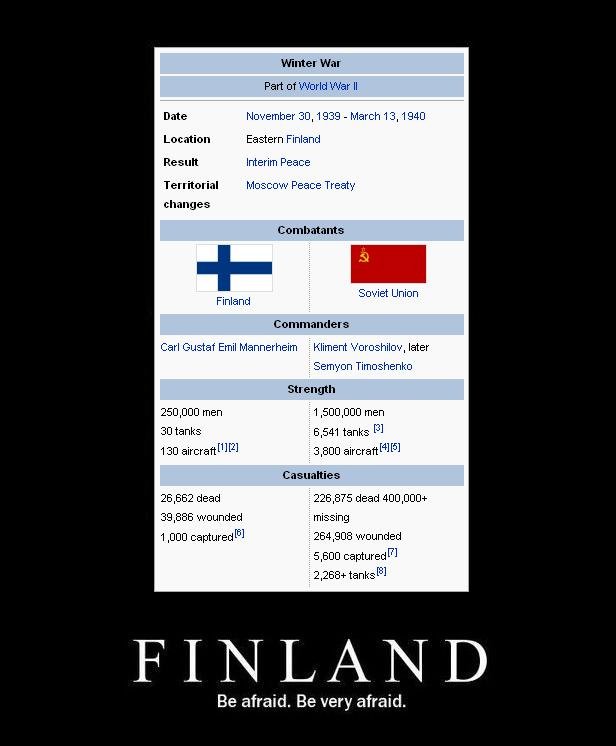
Funny but true. You gotta love statistics. 
The war continued on for close to 5 months. The Soviets had not been prepared for a drawn out war against the Finns, thinking that the invasion would end shortly after the bombing of the capital. However, the Finns were not interested in handing back their independence after such a short time. Their resilience proved an unexpected challenge to the Soviets and drove the Finns to extreme measures, including signing an alliance treaty with Nazi Germany. This decision would result in Finland being forced to pay war reparations to the Soviet Union until the mid 1980's. However, this burden placed on a fledgling nation proved to be the catalyst to Finland's industrialization and modernization. The years following the Winter War saw the transformation of Finland into a sophisticated, technologically driven, innovative country that would revolutionize phone and video game technology. The Winter War remains a tangible part of Finnish history and is critical to understand if you even want to try to make sense of the Finnish identity.


Thursday, April 30, 2015

A Historian at the Cinema: When The Moors Ruled Europe

For most of us, world history classes are really just a bad code word for European history. Most people are aware of the basic of European history (Roman Empire, then Dark Ages, then Renaissance, the fast forward to World Wars and that's the gist of it). A part of European history that is often overlooked due to an agenda or pure ignorance is the period of 700 years in which the Moors, North African Muslims, controlled and ruled Spain and Portugal between 711 to 1492 CE. What resulted from this conquest of the Iberian peninsula was a thriving, modern, and sophisticated society during a time when the rest of Europe was living through the Dark Ages.

The documentary film, When the Moors Ruled Europe, produced by the British Acorn Media company and presented by historian Bettany Hughes, guides viewers through this history that although forgotten by many but that is still visually and physically present throughout the Spanish and Portuguese countryside. Sites such as Andalucia, Granada, and Cordoba contain the physically remains of this high period in European history. Hughes takes the audience through a history that began in conquest and the creation of the kingdom of Al-Andalus (modern day Spain, Portugal, and southern France). Tariq ibn Ziyad lead the Moorish army against the Visigoths, who would eventually surrender. However, life under the new Moorish empire in southern Europe was complex. Moorish rulers allowed Christians to be governed by Visigoth law and the many willing Muslim converts, who converted despite little immigration from north Africa, to live under Moorish law. In addition, Arabic became the language of the land. These two factors help explains the large influence Islam had on Iberian (and as a result South American) culture and customs and the large amount of Arabic origins in the Spanish language. These long lasting influences of the Moors demonstrate how deep an impact the 700 years of Moorish rule had upon the people of southern Europe. More interestingly, the documentary is quick to point out that Moorish Europe experienced a Renaissance many hundreds of years before the rest of Europe. During this period, the Moors developed renowned learning centers and libraries, advanced medicine that would not be seen in Europe until the discovery of germs, and practical technology such as sewer and water systems. However, the Moorish Empire of Al-Andalus would eventually come to an end during the Reconquista which would end with Ferdinand and Isabella as king and queen of the newly re-Christian Spain in 1492. With Christian rulers in control of the region, Spain would quickly move to forget and cover up their Moorish history. This effort to forget the Muslim empire in Europe would prove successful up until current day when the majority of text books gloss over or omit any references to Moorish Europe. This documentary aims to bring back this history to the general population and to the popular record.

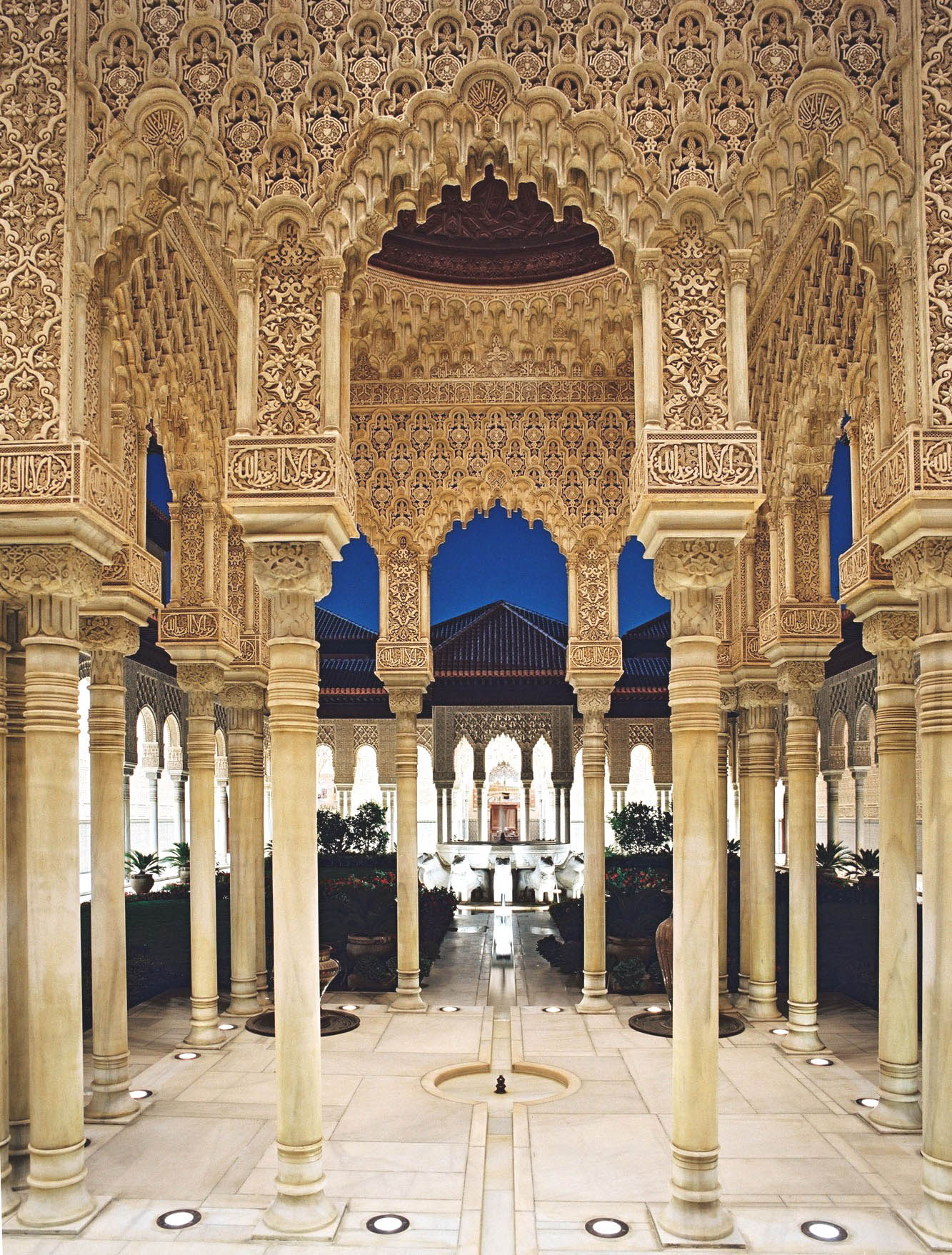
Alhambra: masterpiece of Moorish art and
architecture located in Granada, Spain. 
The high light of this film, aside from the clearly explained and rich history narrative, is that it draws upon the architectural heritage of Moorish Spain. Hughes explores and narrates this complex history while strolling through the regal and geometrically designed palaces such as Alhambra. Audiences are presented with the beautifully preserved remains of Moorish Spain as they learn about the civilization that built them. Instead of the typical Ken Burns style of slowing panning past antique photos of people and places, the producers of this documentary chose to film on site of each of the Moorish palaces or cities and used reconstructions or images during certain moments. This decision enriches the experience because it reveals to audiences the physical impact of this civilization. More importantly, the documentary does excellent work at explaining a complex 700 year history in only two hours. It serves as a primer, a well detailed one, for those interested in learning about this missing chapter in European and Arab history.

I found this documentary through a recommendation from my Arabic professor. My background as South American made this documentary all the more interesting. Learning about how Latin American traditions came from Arab and Muslim culture was enlightening and something that is rarely talked about. It revealed an aspect of the history of the Spanish language that I had never heard before and helped answer many of the questions I had about our deep seeded traditions. For this reason, I most definitely recommend this documentary to people of South and Central American decent. It provides an understanding of another layer in our extremely multicultural history. For others, it will also provide an enlightening re-examination of that European history you learned in high school social science class. The beauty of history is that it is constantly in a process of discovery and rediscovery, and it is this process that makes us richer as a society and as people.


Sunday, April 19, 2015

Dead Sea Scrolls: The Exhibition


This weekend Amanda and I took a day trip up to Los Angeles to visit the California Science Center to see the Dead Sea Scrolls exhibit. The scrolls are on exhibit here for the next couple of months on loan from the Israel Antiquities Authority. The exhibit consists of a selection of the Dead Sea Scrolls and other artifacts from Israeli archeological sites. This is the first time the nearly two thousand year old Dead Sea Scrolls have visited Los Angeles and the first time in a while that they have been in the United States. The scrolls were found by Bedouins shepherds in 1946 when, according to legend, one threw a stone into a cave off the banks of the Dead Sea and heard pottery shatter. Inside was where they found the scrolls now known as the Dead Sea scrolls. The first discovery lead to a team of archeologist leading a search around the initial cave and neighboring caves. For the next several years archeologists discovered more scrolls that contained some of the most important texts to Judaism, Islam, and Christianity. To this day, historians, archeologists, and theologians debate the origin of the scrolls and their authors. However, what is not in dispute is their importance to Abrahamic religions. They provide some of the oldest scripts of what would eventually make up the three largest religions in the world.

The Dead Sea Scrolls (or Dead Sea Jerky)
The exhibit just recently opened and the museum was packed when we arrived. The ticketed event took almost an hour of waiting in line to enter. Once we entered it became clear that the exhibit lacked a sense of direction or narrative. We were lead into a room with three large screens and three large antique containers. The screens showed the Dead Sea and very little understanding of what the visitors were suppose to do. I was expected a introductory video. Finally, the docent came in and began to explain the exhibit and gave some background information about the scrolls. Once he finished he explained how to enter the exhibit. However, upon entering it we were overwhelmed with many artifacts but very little explanation about what they were or what they were for.

After about two rooms of assorted jars, pillars, and small ivory carvings, we finally reached the Dead Sea Scroll room. On a large circular display case, visitors circled around (slowly I might add) to read the translation and minimal explanation of each section. To my surprise, the Dead Sea Scrolls were remarkably small. Made of animal skin, the script on the scrolls were very faded and took close inspection to see. In some you could see the lines the scribe had drawn to align the script. Sections came from different scrolls and represented the variety of text. Some were old Bible texts, one was a marriage contract, and another included a collection of Psalms. The collection on display make up a small percentage of the entire Dead Sea Scrolls and, in my opinion, where not the best selections for viewing. Their small size and bad display made it difficult for visitors to examine the scrolls. Despite this, I really did enjoy the opportunity to see the artifacts that play such a large role in world religion. I recommend this exhibit because it is such a rarity for these artifacts to be in Los Angeles area but also because there is no guarantee that they will be back again. This being said, I was not happy with the display and organization of the exhibit. I hope to visit Israel to see the full collection (hopefully that exhibit includes more information and a better layout) but until then I am content to have seen this rare exhibit opportunity.