Pages

Showing posts with label historian reads. Show all posts

Thursday, May 21, 2015

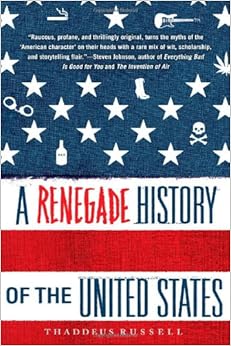
A Historian Reads: Renegade History of the United States

Renegade historian writes the renegade history of the United States is a great way to describes Dr. Thaddeus Russell's most recent book (his previous book Out of the Jungle will be reviewed soon). Labor and Americanist historian Dr. Russell went from tenure track position at Bernard College to an adjunct (not tenured or secured) position at Occidental College because of his unorthodox approach to history. So it is natural that he would go onto write his answer or response to Howard Zinn's People's History of the United States and Micheal Allen and Larry Schweikart's Patriot's History of the United States. For those unfamiliar with these books, they are considered the right and left wing version of American history. Those who love one tend not the like the other. Russell comes from an approach that is radically different than the people's or the patriot's. He approaches American history from the point of view of renegades, degenerates, criminals, and ne'er do wells. In A Renegade History of the United States, Russell attempts to introduce renegades as the hero of American history.

In both People's and Patriot's, the heroes of American history are the hard working and law abiding Americans. Russell counters this idea by proposing that it is the criminal and renegade class of Americans who should be thanked for the freedom Americans enjoy today. Without the drunkards of Boston, many of the early incidents in the movement for American independence would not have occurred. He points out that the Founding Fathers of America were deeply troubled by the behavior Americans exhibited. John Addams wrote about his abhorrence for public dancing and open prostitution that were common in the colonies. It was during this time that the American colonies became a safe haven for Europeans looking for sexual promiscuity. In the cities it became common for women in lower socio-economic classes to own bars, ask for divorces, and have children out of wedlock without much consequence. Bars, brothels, and saloons were often mixed race. This did not sit well with the Founders and often caused doubt if independence was indeed worth the price. Russell uses this to demonstrate that it was not the Founding Fathers who we should thank for the continuing spirit of rebellion and freedom of association. Rather, it is those who chose hedonism and social impropriety that resisted attempts at "civilizing" by an elite class that wanted to remodel the newly independent nation into a British styled imitation.
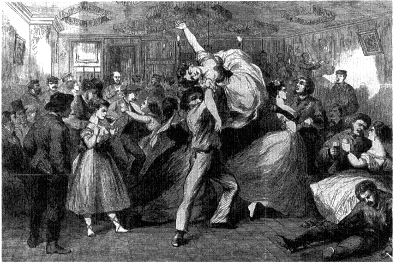
Ahh! People dancing and having fun!
Moving into the twentieth century, Russell continues the narrative of how those deemed by society as "renegades" or "outsiders" do more for preserving essential individual rights than any political class. In the case of Prohibition, it is the mafia that serves as the defender of LGBT rights. In a history that is rarely discussed, Russell explains how during a time when the Mafia was busy outmaneuvering the law in order to fulfill American's thirst for illegal alcohol, they found a common interest with the LGBT community. Gay bars were still operated under secrecy and with the advent of Prohibition they found themselves trying to hide both their alcohol and their true nature. Despite the heavy influence of Catholicism within the Italian mafia, the Cosa Nostra entered into a partnership with many gay bars, providing them with alcohol and protection from the police. With many police officers and departments under their influence, the mafia found it beneficial to protect gay bars from raids and use them as distributors for the main source of income. This mutually beneficial relationship helped preserve gay culture in America throughout the early twentieth century.

Although you may not find yourself agreeing with all of Russell's conclusions, his book does do an excellent job of providing a new lens to approach history. Instead of a Marxist or "Great Man" approach, he offers history and the struggle for civil and individual rights as one that pits "the proper class" against those who resist it in favor of doing what they wish to do as a renegade. He introduces new heroes to American history such as prostitutes, criminals, the mafia, and drunkards as the true defenders and activists for many of the rights we enjoy today or are slowly recovering. It may not sit well with many, but renegades are the source for instigation that is needed to reclaim rights that are unfairly taken or withheld from many Americans throughout our history. I thoroughly enjoyed this book and Russell's radical perspective and would recommend it to everyone looking for a different approach to American history outside of the two sided, left vs right dichotomy. This book asks you to open you mind a little bit and to reconsider the narrative of this nation's history.


Saturday, April 25, 2015

New Series! A Historian Reads: American Desperado

Following the beginning of our film review series, we thought it appropriate to begin a book review series as well. Historians do a lot of reading (heads up for anyone interested in entering the field), but it also happens to be a passion of ours. We will review books that deal with history but they could come from different fields and include fiction and non fiction.


After reviewing the documentary Cocaine Cowboys I thought it might be interesting to introduce you to one of the books used for the making of that documentary. American Desperado is the autobiography of one of the infamous cocaine cowboys, Jon Roberts. If you read the review of that film you will know that the cocaine cowboys refers to the period of extreme drug gang violence that occurred in South Florida during the 1980's and 1990's. Participants in this violence were called the cocaine cowboys because of the lawless nature that the region had developed.

Jon Roberts was one of these cocaine cowboys. A New York native, Roberts was one of the non-Colombian affiliates of the active cartels in South Florida. He began working as a distributor in New York in the club scene during the early 1970's and found it to be a lucrative occupation. However, he moved to Florida when the drug trade through the Caribbean exploded. Cocaine became a desired drug and the main supplier, Colombian cartels, developed extensive trade networks to get their product to the United States. Jon Robert's experience with the Gambino crime family in New York made him a perfect candidate to begin working with the up and coming Colombian cartels. Roberts claims that Cuban cartels in the area were having difficulty bringing in enough product to meet demands. Colombian cartels, who had been working exclusively in production, moved to expand their empire into manufacturing and distribution. Cuban and Colombian cartels were soon in conflict and Roberts found a niche within the Colombian cartel organization. He soon went to work with another American, Mickey Munday, a pilot who used his expertise in flight and navigation to bring up cocaine undetected. Both Roberts and Munday would eventually come under the radar of the South Florida Drug Task Force organized to deal specifically with the cocaine cowboys. A raid would lead to the arrest of Roberts and the escape of Munday. Under arrest, Roberts would eventually turn criminal informant helping the U.S government bring down many of his former colleagues.


Jon Roberts with co-author Evan Wright
This autobiography is an disturbing look into the late twentieth century drug trade by one of its important figures. Interest in this book has gone up recently since Mark Wahlburg has announced interest in making a film based on the autobiography with Wahlburg starring as Roberts. This news makes me uneasy because Hollywood does not have a good record in making accurate film about history in general, the drug war, and Colombians (that will be its own stand alone post/rant). We shall have to wait and see if this film turns out to be another misinformed glamorization film or maybe something closer to the truth. And the truth is that Roberts lived in a violent world and the nonchalant style of Robert's memoir reflects this. It becomes unsettling to read about the acts he committed or was involved in described in such a matter of fact style. Interestingly, since Roberts' death his co-author, Evan Wright, added an epilogue in which he describes his own uneasiness with Roberts' personality and violent past. Wright describes how he feared Roberts as certain times during the process of helping him write the book. As a reader, I found myself experiencing something similar to Wright. Despite this, I do believe this is an important book to the history of the drug war. It reveals the world from the inside out and demonstrates how the drug trade benefited by the war on drugs and the political climate of the United States. Moreso, Roberts' autobiography allows readers to understand the reality of the drug trade outside of the hyper-hysteria of the press and glamorization of the media that most people are familiar with. As this book shows, reality is often more horrific and sensational than anything a filmmaker than make.