Pages

Showing posts with label book review. Show all posts

Tuesday, September 15, 2015

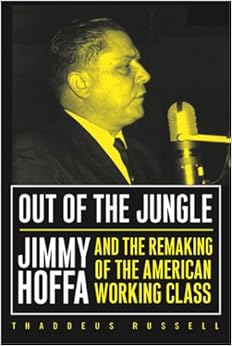
A Historian Reads: Out of the Jungle

When you hear the name Jimmy Hoffa what comes to mind? Probably that recent news alert when they thought they found his body under some concrete? The mob most likely? His disappearance under “suspicious circumstance”? Of course you do. It is very hard to separate Jimmy Hoffa from the Boston mob history of the late twentieth century. But is that all there is to the man? From a historians point of view, absolutely not. Jimmy Hoffa is representative of an internal fight among labor unions in the twentieth century. As leader of the International Brotherhood of Teamsters, Hoffa’s legacy is much more important that his acquaintance with the mob. In “Out of the Jungle,” historian Thaddeus Russell tells the story of the Teamsters as seen through the life of Jimmy Hoffa.

We have previously reviewed a book by Thaddeus Russell on general American history, however this is Dr. Russell’s specialty and it shows in this academically published book. The tone is much different and his sarcastic wit is much more subdued. However, it is well researched and acclaimed by other historians for being a novel addition to the field of labor studies.  The concept of using a singular person to explore the history of a movement or subject is not new but is applied masterfully in this book. Hoffa grew up within the Teamsters organization and by following his leadership and conflicts with other labor leaders, Russell weaves a fascinating tale about labor disputes among unions and the government.

Russell argues that Hoffa made his way up the leadership of the Teamsters due to his “practical and pragmatic” style. Instead of using ideology and idealism, Hoffa gave substantial wins to his supporters . Hoffa was not a philosopher or social leader, rather he was a working class man who fought (negotiation wise and physically) for a part of the economic pie everyone else was enjoying. He did not align himself with other labor leaders who were interested in remaking society and as a consequence could only offer their follows promises and hope. His associations with the mob and crooked politicians make sense when seen through the lens of his pragmatic strategy. Unfortunately, it would be those same alliances that had helped his cause that would land him in jail and then on a missing poster.  


As I said earlier, this book is written for an academic audience and for that reason the humor and sardonic jabs that littered his most recent book are gone. This is not to say it is a dry read, but the tone stays serious for the duration of the book with small moments of Russell’s sense of humor. I recommend this book but I want to stress this book’s intended audience. Russell discuses historiography and methodology as should any historian but this may be a turn of for some mainstream readers. These sections of the book are slow to read and seem inconsequential for people interested in getting right to the history of Jimmy Hoffa. However, I highly recommend spending time reading those sections and enjoying the book as a whole. It is a fascinating read for those interested in labor history and for those of us, like me, who are relatively uneducated in labor history. More importantly, it will help you develop a much better response for the question, “what do you know about Jimmy Hoffa?”

Saturday, May 23, 2015

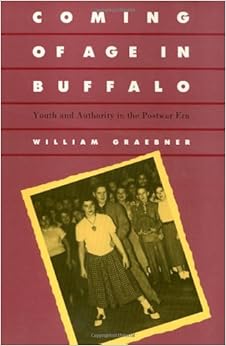
A Historian Reads: Coming of Age in Buffalo

As the previous review of Grace Palladino's Teenager: An American History noted, studies of youth and youth culture have unfortunately fallen to the trap of homogenizing a culture in the efforts to understand it. William Graebner's 1987 book Coming of Age in Buffalo was an early attempt to introduce diversity to the study of youth. He argues that youth are not all the same across the nation. Instead of approaching youth strictly as an age group, Graebner offers readers the option of looking at youth through the regional, racial, social, religious, and economic sub groups that they belong to. He does this by presenting Buffalo, NY as a case study and example of how to approach youth from the regional perspective.

Youth in Buffalo are divided by race and religion, notes Graebner, and this impacts how these youth interacted and behaved. Also important to note, is that these differences also influenced how adult authority figures reacted to these youth and their feelings towards them. Graebner uses school yearbooks, church pamphlets, and parent teacher association publications to teach readers about these divisions. However, Graebner quickly notes that these materials, even those produced by high school students, are ultimately filtered through adult authority figures and embedded with their ideas of propriety and youth. Here he stumbles upon one of the greatest problems facing historians of youth cultures and "deviant" cultures. They are rarely the creators of the primary sources about them. As seen in studies regarding teenage pregnancy in the 1940's and LGBT communities in the early twentieth century, many of the primary sources used by historians in their research are created by those in the dominant culture who record these communities and individuals using their social lenses. Youth are similarly impacted by these phenomenon because much of what they consume or create is done through the help of adults who generally exercise greater power and influence. Graebner identifies this issue and quick to note the fallacy that it creates. Studying youth often leads to greater information about adults.

This books is relatively short in length for a university press, however it is packed with detailed information about Buffalo teen culture and the diversity within. It does so through very clear writing and organization that is never confusing, overwhelming, or dull. More importantly, Graebner adds a unique spin to the tradition academic history book and includes large photos, articles, drawings, and ads from Buffalo that have an almost "scrapbook" feel. It involves the reader to a larger degree because no longer are you just reading about teen hang outs but you see photos of actual teenagers in Buffalo at a friend's house listening to music. It takes history out of the inhuman analysis and reminds us that our subjects lived and experienced life the same way we did.

Despite methodological issues that appear with a study about youth, Graebner moves the literature forward by acknowledging these trappings and using this admission to make a better analysis of youth. However, it is Graebner's approach to the generalization of youth that makes this book so noteworthy. His ideas, although provoking, did not catch on in the study of youth despite the influential nature of his book (it is frequently cited in academic and popular publications about youth and the 1950's until today). I believe it is a book worth revisiting for its theoretical thesis and can be used to inspire more detailed and localized studies of youth in America. For too long, American youth have been categorized into a homogeneous label that ignore the richness of natural diversity and this is doing more harm than good to the study of youth.

Thursday, May 21, 2015

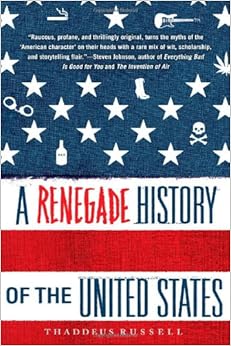
A Historian Reads: Renegade History of the United States

Renegade historian writes the renegade history of the United States is a great way to describes Dr. Thaddeus Russell's most recent book (his previous book Out of the Jungle will be reviewed soon). Labor and Americanist historian Dr. Russell went from tenure track position at Bernard College to an adjunct (not tenured or secured) position at Occidental College because of his unorthodox approach to history. So it is natural that he would go onto write his answer or response to Howard Zinn's People's History of the United States and Micheal Allen and Larry Schweikart's Patriot's History of the United States. For those unfamiliar with these books, they are considered the right and left wing version of American history. Those who love one tend not the like the other. Russell comes from an approach that is radically different than the people's or the patriot's. He approaches American history from the point of view of renegades, degenerates, criminals, and ne'er do wells. In A Renegade History of the United States, Russell attempts to introduce renegades as the hero of American history.

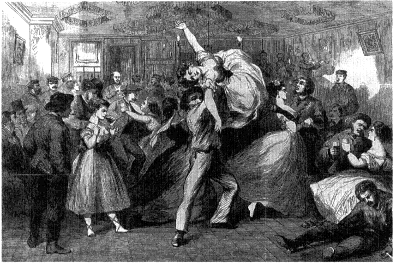
In both People's and Patriot's, the heroes of American history are the hard working and law abiding Americans. Russell counters this idea by proposing that it is the criminal and renegade class of Americans who should be thanked for the freedom Americans enjoy today. Without the drunkards of Boston, many of the early incidents in the movement for American independence would not have occurred. He points out that the Founding Fathers of America were deeply troubled by the behavior Americans exhibited. John Addams wrote about his abhorrence for public dancing and open prostitution that were common in the colonies. It was during this time that the American colonies became a safe haven for Europeans looking for sexual promiscuity. In the cities it became common for women in lower socio-economic classes to own bars, ask for divorces, and have children out of wedlock without much consequence. Bars, brothels, and saloons were often mixed race. This did not sit well with the Founders and often caused doubt if independence was indeed worth the price. Russell uses this to demonstrate that it was not the Founding Fathers who we should thank for the continuing spirit of rebellion and freedom of association. Rather, it is those who chose hedonism and social impropriety that resisted attempts at "civilizing" by an elite class that wanted to remodel the newly independent nation into a British styled imitation.

Ahh! People dancing and having fun!
Moving into the twentieth century, Russell continues the narrative of how those deemed by society as "renegades" or "outsiders" do more for preserving essential individual rights than any political class. In the case of Prohibition, it is the mafia that serves as the defender of LGBT rights. In a history that is rarely discussed, Russell explains how during a time when the Mafia was busy outmaneuvering the law in order to fulfill American's thirst for illegal alcohol, they found a common interest with the LGBT community. Gay bars were still operated under secrecy and with the advent of Prohibition they found themselves trying to hide both their alcohol and their true nature. Despite the heavy influence of Catholicism within the Italian mafia, the Cosa Nostra entered into a partnership with many gay bars, providing them with alcohol and protection from the police. With many police officers and departments under their influence, the mafia found it beneficial to protect gay bars from raids and use them as distributors for the main source of income. This mutually beneficial relationship helped preserve gay culture in America throughout the early twentieth century.

Although you may not find yourself agreeing with all of Russell's conclusions, his book does do an excellent job of providing a new lens to approach history. Instead of a Marxist or "Great Man" approach, he offers history and the struggle for civil and individual rights as one that pits "the proper class" against those who resist it in favor of doing what they wish to do as a renegade. He introduces new heroes to American history such as prostitutes, criminals, the mafia, and drunkards as the true defenders and activists for many of the rights we enjoy today or are slowly recovering. It may not sit well with many, but renegades are the source for instigation that is needed to reclaim rights that are unfairly taken or withheld from many Americans throughout our history. I thoroughly enjoyed this book and Russell's radical perspective and would recommend it to everyone looking for a different approach to American history outside of the two sided, left vs right dichotomy. This book asks you to open you mind a little bit and to reconsider the narrative of this nation's history.


Sunday, May 17, 2015

A Historian Reads: Sin No More

In a class about vice crime, we were assigned to read our own professor's book. At first this came across as somewhat narcissistic and self serving, until I read it and realized that it was a great book. Sin No More: From Abortion to Stem Cells, Understanding Crime, Law, and Morality in America by Drs. John Dombrink (my wonderful professor) and Daniel Hillyard explores the space where morality and the law intersect. In criminology, there is a distinction made between crimes with victims (murder, assault, burglary etc) and those that are victim-less, otherwise known as vice crimes. Crimes with victims are generally not dispute about their status as a crime. It is hard to argue that murder is something we should allow as a society. Vice crimes, however, are less black and white. They bring up questions about morality, the role of government to enforce morality, and the purpose of the law.

As seen in the subtitle, this book covers topics as diverse as abortion, stem cells, marriage equality, gambling, and others. Both authors take a historical perspective to the topics and divide each chapter by type of vice crime. They then explore the historical development of the vice crime including how they came to be (or in some cases, reappeared), their origins with specific ethnic groups or social classes, the legislation written in response and modern debates surrounding their legality or illegality. In doing so, the authors bring out the nuances and unique debates that each topic creates rather than generalizing patterns of legalization and criminalization.

From Stonewall to the Facebook trend.
Dombrink and Hillyard note that on a whole,
trends are in favor of decriminalization
However, there is a greater overarching lesson to be learned through their historical and sociological analysis. Regardless of what vice crime you focus on, there is a national trend towards becoming more tolerant of these behaviors and peeling back the legislation that wastes money towards prosecuting victim-less crimes. Despite, social conservative cries about the decaying morality of the United States, it would appear that we are just becoming more tolerant of these former "immoral" behaviors in a healthy fashion. Just as legalizing heroin in Portugal did not cause the entire tiny nation to become heroin users, and legalizing gay marriage in most of Europe did not result in every getting gay married, so shall the United States pass into a state that worries less about their neighbor's behavior inside their home and focuses on actual physical crimes in which victims are due their justice.

Because I had Dr. Dombrink as a professor, I got the opportunity to talk with him a lengths about his approach to law, crime, and society. Something unique about his approach is that he is very aware of the left right paradigm that exists within a lot of research and views this as a biased way to treat the American public. He acknowledges the variety and hybrid political views that Americans have and uses this to hone his analysis. Rather than see increased tolerance as a rise in liberal thought, he instead sees it as a rise in individualist and libertarian ideas that he views as a common feature of millennials, regardless of the political affiliation. This new (at the time of publication in 2007) approach lends itself to a less political analysis and a more human one. Dombrink and Hillyard see these trends as reflective of humanity rather than of any political or economic development. At the end, the authors are positive and hopeful for the American political scene and trust that as people become less judgmental and less interested in controlling the behavior of others so shall the system slide in their favor.


Tuesday, May 5, 2015

A Historian Reads: American Nations

Since the publication of Benedict Anderson's Imagined Communities in 1983, academics across the disciplines have had to reexamine their understandings of the nation state. In today's world, it is natural to think in terms of "the nation" and the national narrative of history. Anderson's seminal work explained the process in which we are socialized to think in terms of the nation and why the nation is a creation of the nineteenth century. Prior to the nation, civilizations existed in terms of empires and kingdoms. The people who lived within these contexts existed as subjects rather than citizens. They have no national identity. Anderson argued that the nation is an imagined community. It allows citizens to believe themselves to be a part of a greater community despite most likely never meeting the majority of this community. In the history of the United States, historians have stuck to a nationalist translation of the country's history. However, Colin Woodard's book, American Nations, goes against this trend and introduces the idea of transnational or regional history into the narrative of the United States.

Woodard divides the national into 11 regions that each contain a different and unique history which explains the modern culture of these regions. He approached the subject by trying to understand the root of today's deep political divides and sees them as a result of these different nations and their varying heritage. These nations are: First Nation, the Left Coast, El Norte, the Far West, Deep South, New Netherlands, Greater Appalachia, Yankeedom, New France, the Midlands, and Tidewater. The book follows history chronologically while also separating chapters by the different nations. An example of a regional history and how he uses it to explain modern political divides is in California. His analysis divides California between two nations: El Norte (Southern California) and the Left Coast (Northern California). The Left Coast is made up of migrants from an eastern nation, Yankeedom, whose residents prized social cooperation, a strong central government, and elitist value. They brought their values and opinions to the little inhabited northern California and successfully established a replica of Yankeedom. However, this created tension between the Protestant Anglo migrants to California and the Catholic Hispanic Californianos who inhabited southern California. These Californianos, who lived in El Norte, were mostly ranchers who prized independence, cultural pride, and quick adaptation. When California was annexed into the United States, the two poles of the states retained their personalities and as time went by would become two very different regions and voting blocks.

From a historical perspective, I find Woodard (a journalist) remarkably groundbreaking. He breaks away from a trend that has plagued the historical field since the days of the U.S revolution and introduced the newer transnational style that better explains historical progression. Transnational history is not anything new to historians, but to the general public it represents a major shift. Woodward does this successfully because of his entertaining, lively, and smart writing. His style of writing is meant for a popular audience, but he does not allow this to prevent him from providing deep analysis and a rich history of each region. Each chapter is filled with details but never does it feel dense or overwhelming, a difficult achievement. Woodard also provides an answer to those skeptics of the humanities and the generally uninterested who repeatedly ask "why is history important? Why does studying this even matter?" He demonstrates that history is a framework to understand our modern world, views, actions, and events. Without understanding historical development and progression, those skeptics will be left misunderstanding and miss-explaining current debates and political shifts. Rarely do things spontaneously occur, there is almost always a progression. Woodard demonstrates that historical understanding is needed more today than ever before.

Saturday, May 2, 2015

A Historian Reads: Teenagers, An American History


In the process of doing any historical writing, it is necessary to do what historians call, historiography. What this means is reading what other people have written about the subject we are interested in. This is an important step for historians because it informs us about our subject but also lets us know what has already been discussed and how it has been discussed. Historians generally do not want to write something somebody else has already written about unless they disagree with the previous account. Either way, historians must dedicate their time to understanding the discourse about their research topic. In my own research I have had to do several groups of historiography because my topic touches on a variety of topic. My study lies within their intersections.

One of the books I have read during my historiography research is Teenagers: An American History by historian Grace Palladino. Palladino's study looks at youth in America from the mid-twentieth century onwards. She explores the concept of youth and "teenagers," which are relatively new constructs in our vocabulary. The teenager, as we think of them today, was discovered during the Great Depression as high schools became mandated and culture became divided by age. During World War II Palladino demonstrates that increased freedom and concern with the war allowed teens to develop a culture separate from adults and young children. Both men and women began to develop their own social structures outside of adult supervision and regulation. Mainly due to the power that disposable income gave them, teenagers created their own ideas about what was desirable, fashionable, and necessary. With the war over, a return to "normalcy" desired by most Americans, and the second Red Scare in full boom, those in power reacted to teenagers. Comics, movies, and music became the target of accusations of communism and subversion. To reformers and parents, these popular culture products were responsible for turning their well behaved children into wild and rebellious delinquents.
Teenagers having fun and disapproving adults looking on.

Palladino's book achieves its goal of expressing American history through the perspective of the teenager. It is ambition and covers a rather large span of time. However, her book has one glaring issue. It ignores the experiences of minority teenagers. Outside of a chapter about African American teens in the South, Palladino's story is about white middle class teens living in the mid-west and east coast. This has been one of the prevailing issues in youth culture studies. Until recently, African American, Latino American, and other minority groups have not been explored as a part of youth culture. An earlier book about youth culture, William Graebner's Coming of Age in Buffalo, expressed the need for historians to look at youth culture as a diverse collection of subcultures that are divided by race, religion, and class. Palladino does not take Graebner's statement into consideration and continues the narrow view of youth that is just now beginning to be expanded. However, Palladino's study should not be dismissed. Palladino persuasively discusses the role of white middle class teens in American social history and insures that readers will leave with a better understanding of what teenagers and teen culture mean in the context of the past century. For the purposes of my research, Palladino does contribute to my own understanding of youth culture and how youth culture has been understood by historians until recent years. More importantly, it provides me with a prime example of why my own research is such a necessary contribution to the field.